
Match Your Vibe. Hunt for the Next Game
There are sensible ways to choose a video game. Genre. Price. Reviews. System requirements. Multiplayer support. Controller support. Whether your GPU is going to run it beautifully or immediately begin drafting its final will and testament.
All useful. But I think there is another part of choosing a game that gets weirdly underrepresented: how do you want the game to make you feel?
Not just, “Do you like RPGs?” I mean do you want to wander through a rainy neon city at 2 a.m. where everyone looks suspicious and somebody is definitely selling illegal cybernetic eyeballs from a noodle shop? Do you want to float through space with a banjo playing somewhere in the distance? Do you want a gigantic fantasy landscape where you spend 45 minutes climbing a mountain because you spotted something shiny over there?
Maybe you want something calm and lonely. Maybe you want noisy and ridiculous. Maybe you want a brutal dystopian city, a tiny farming village, a giant unexplored galaxy or a haunted coastline where nobody seems emotionally prepared for what is happening.
Now we are getting somewhere.
That is the idea behind the Video Games Choice Compass.
This particular Choice Compass is also a bit of an experiment for Octivary. Up until now, the information going into these things has largely been manually gathered, researched and audited. For video games, I am testing what happens when Octivary taps into an outside information source instead and uses a game catalogue API to help populate the underlying listings.
I am still reviewing what comes through because APIs are not magical truth dispensers. They are more like extremely fast research assistants who occasionally hand you a folder labelled “probably correct.” But starting from structured game information opens the door to covering far more games than I could reasonably research one by one while slowly transforming into an NPC at my desk.
And video games are exactly where I wanted that larger playground.
The Feeling a Game Leaves Behind
World building and world journeying sadly feel extremely enticing right now. Especially after watching the news for 20 minutes.
Sometimes I do not want more information. I do not want another notification. I do not need Breaking News Man shouting from the television while six banners scroll underneath him and my phone lights up with another alert informing me that apparently everything continues to be on fire. Sometimes I would instead like to be given a sword, a spaceship, a fishing rod or perhaps a deeply questionable horse and disappear somewhere else for a while.

Video games can do that in a way I still find kind of incredible.
There is one game in particular that I keep going back to mentally, and sometimes literally, from the late 1990s: Starsiege: Tribes.
I remember more than the game. I remember the room. My desk had one of those transparent telephones where you could see all the gizmos inside making the thing work. This was apparently peak technological sophistication to young me. My walls were plastered with grunge bands. The carpet was not shag carpet, but it was certainly not the thin sensible carpet we install today either. It occupied some mysterious middle evolutionary stage.
And I was very grateful and blessed to have one of those five-CD rotating stereo systems.
Five CDs. At once. With BASS BOOST. We were basically running a data centre.
Then there was Tribes, released in 1998, where I could suddenly strap on a jetpack and float around enormous landscapes fighting other players online. It received a lot of recognition in its time, but its place on an award list honestly has very little to do with why I remember it.
I remember the feeling. The giant maps. The freedom. The strange loneliness of travelling between bases. The jetpack. That late-'90s PC-game atmosphere where everything felt experimental because online multiplayer itself still felt slightly illegal.
[ jetpack noises intensify ] ~~>
Unfortunately, some of those memories come bundled with another historically authentic component of early online gaming: cheating.
Moderation tools were not exactly operating with 2026 levels of sophistication, so eventually I would encounter players who seemed to possess the accuracy of a military targeting satellite, the speed of an intercontinental missile and possibly the blessing of several minor gods. Young me naturally reached the obvious conclusion that I was simply terrible at the game.
Eventually I caught on. So did everyone else.
Cheating was not the only reason communities changed over time, obviously, but watching once-busy servers gradually become quieter was strange. Somehow, though, Tribes still refuses to completely disappear. If you go looking in 2026, there still appear to be active community servers and actual human beings playing the thing.
That blows my mind a little. More than two decades later, somebody can still wander back into that world.
Some Games Absolutely Nail Their Own Atmosphere
Nintendo has repeatedly demonstrated an almost suspicious ability to manufacture a specific feeling with The Legend of Zelda. You can have enormous technical differences between Zelda games and still recognize that particular flavour of curiosity. Something interesting is over there. There is probably a path to it. You absolutely will ignore the path and attempt to climb something Nintendo did not intend you to climb.
Then there is Outer Wilds, from Mobius Digital.
I am not even getting into playability here because that is an entire other campfire. I simply have to mention it when talking about atmosphere because the music serves that world so ridiculously well. Andrew Prahlow's soundtrack is one of those scores where the music is not merely decorating the game. It feels structurally attached to the experience.
Truly a work of art.
And that is the thing I wish more people understood about game development. What these creators build using code, engines, visual design, animation, writing, audio engineering, music, networking, physics, lighting, UI design, level design and approximately nine thousand other disciplines blows my mind. A modern game can be a little civilization of specialized skills that somehow has to ship as one functioning object.
Then they release it into one of the most competitive entertainment markets on Earth and somebody immediately writes:
7/10. Horse walking animation kinda weird.
Good luck have fun.
Please folks, if you are going to review games and give negative feedback, make it constructive so that the creator can actually learn and grow. There is a gigantic difference between “this mechanic became repetitive after a few hours and here is why” and firing a one-star tomato directly through somebody's digital window.
Game development is hard enough without feedback shaped like a brick.
The Special Sauce That Is Hard to Put in a Database
That feeling is exactly why I wanted to push the Video Games Choice Compass harder toward vibe.
I think atmosphere is one of gaming's unsung ingredients. When developers hone it correctly, players do not merely like a game. They want to go back there. That difference matters.
Unfortunately, this is also where my shiny new API experiment looked at me and basically said, “Best I can do is genre.”
The information source gives Octivary plenty to work with, but not nearly as much explicit information about feel as I hoped. A database can tell me something is an RPG, adventure game or shooter. It might identify themes and mechanics. Asking it whether a game feels like “peacefully trespassing through a melancholy dystopian landscape while synthesizers gently ruin your emotional stability” is a slightly taller order.

So I tried to work around that. I split descriptive concepts into different Choice Compass sections so you can prioritize the pieces that matter to you. Maybe you want dark and gritty. Maybe colourful and whimsical. Maybe calm exploration. Maybe a busy neon science-fiction city where every surface has twelve holograms attached to it.
I won't yuck your yum, hun. I'm just trying to get you to the thing.
I also hope to eventually find other game catalogues with even richer information so I can better decipher that elusive vibe and hand-deliver it to you with a cheesy Power Glove. The current catalogue is a starting point, not the grand finale. My hope is to expand this from roughly 500 games into thousands of games over time.
That matters for another reason too. More games means more room for smaller developers, indie teams and creators who may not already dominate every recommendation page to have their art surfaced. There are probably incredible games buried several pages deep in storefronts right now because the algorithm decided we all wanted to look at the same 40 titles again.
I would love for Octivary to help crack that door open a little wider.
Finding the Experience Instead of Just the Genre
One of the harder questions people run into is, “How do I find a game that feels like another game without just finding a clone?” Search engines often answer that by matching genre and mechanics. You search for games like an open-world RPG and congratulations, here are 47 other open-world RPGs wearing slightly different hats.

But maybe that was not actually what you loved. Maybe you loved roaming. Maybe it was solitude. Maybe it was discovering tiny stories without having twelve quest markers screaming IMPORTANT BUSINESS THIS WAY. That is where I would start with atmosphere, setting and exploration style first, then layer gameplay requirements underneath. You are basically reverse-engineering your own nostalgia. Tiny emotional forensics lab. Very normal activity.
Another common problem is not knowing what genre you want at all, and that is completely fine. Ignore genre for a minute. Start with something you do know. Maybe you want something cozy, something set in space, something heavy on exploration or something you can play for 40 minutes after dinner without needing to grind some XP until your eyeballs turn into loading icons. Those preferences can be much more revealing than deciding whether something technically belongs under RPG, simulation, action-adventure or whatever hybrid taxonomy creature has crawled out from beneath Steam this week.
Then there is the other trap: “How do I find something new when recommendation algorithms keep showing me the same kinds of games?” Recommendation systems can become very good at recommending your own history back to you. You played this, therefore you will play This 2. Looks good to me.
Sometimes you actually want to branch out.
That is another place where I think the Choice Compass could be useful. Maybe you love a particular set of mechanics but want a completely different theme wrapped around them. Keep exploration, crafting and progression high on your list, but swap fantasy forests for deep space. Keep tactical combat but ditch military realism for something colourful or supernatural. Keep the mechanics you already know your brain enjoys and change the wallpaper, furniture, weather system and possibly the entire century.
Same skeleton. New haunted mansion.
How I Would Use the Video Games Choice Compass
The most important thing to remember with any Octivary Choice Compass is that your highest priorities carry the most influence.
You can drag the sections up and down to rank them by importance. That ranking matters because it helps determine the score and pushes games that better match your highest priorities closer to the top.
So if atmosphere matters more than multiplayer, drag atmosphere higher. If controller support is mandatory because keyboard gaming turns your left hand into an angry little claw, move it up. If co-op is the entire point because you are trying to keep a remote call from devolving into everyone staring silently at their own cameras, give it more weight.
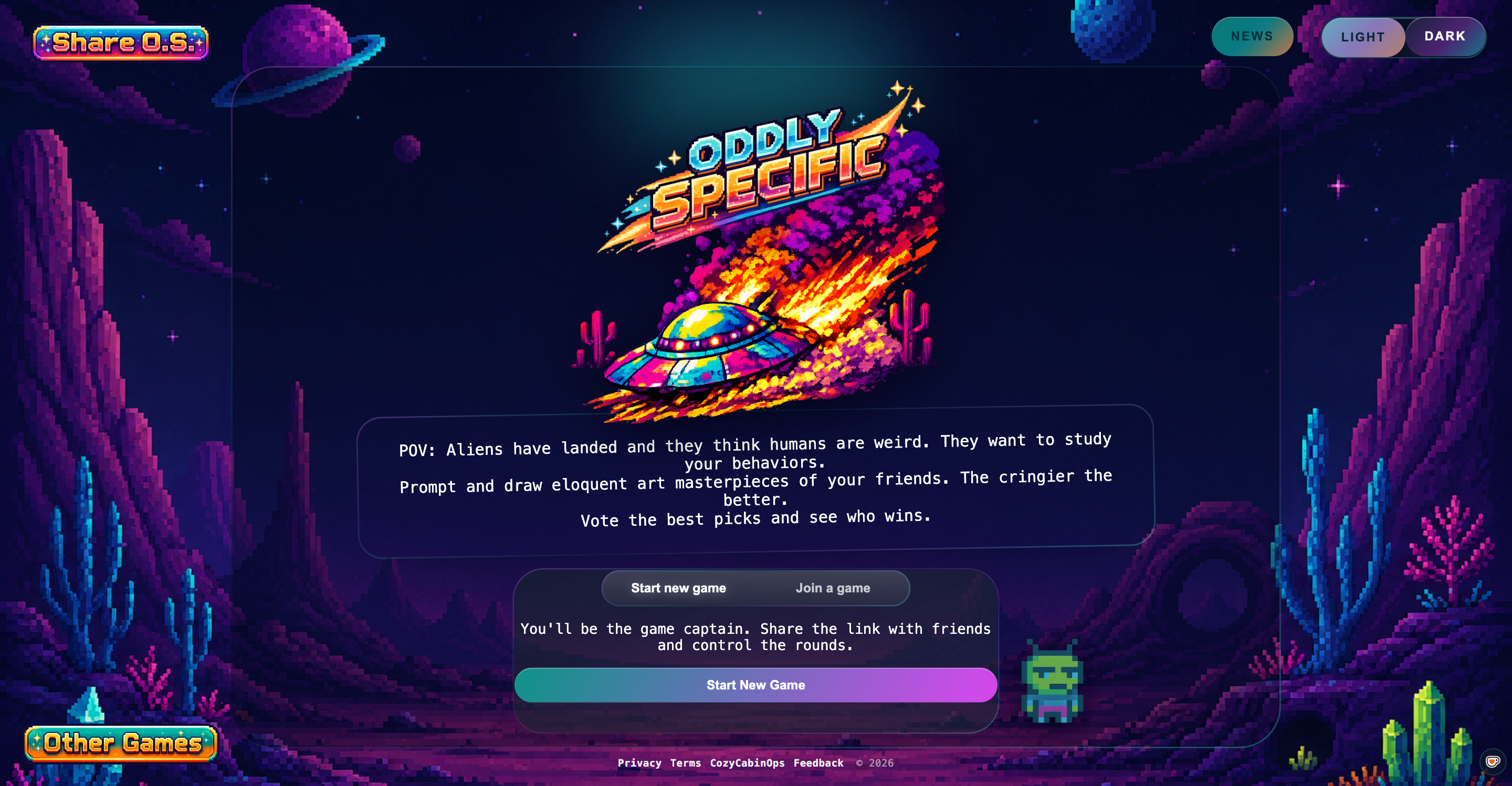
Incidentally, I casually wandered into that exact problem myself and made an online multiplayer drawing game called OddlySpecific at oddlyspecific.games. It is specifically intended for remote calls, because apparently I looked at virtual meetings and thought, “These need drawings and bad decisions.”
For the Video Games Choice Compass, though, do not select every option just because everything sounds vaguely nice. That turns your carefully tuned compass into a junk drawer. Choose the things that make you immediately think YES, THAT, rank those sections higher, and then treat the results as a shortlist rather than a divine proclamation from the Game Oracle.
The text search is also especially useful because games contain ridiculously specific concepts that would be impossible for me to turn into individual filter buttons without producing a UI the length of a pharmacy receipt.
Search for words such as zombie, detective, vampire, robot, farming, dystopian, medieval, survival, underwater, steampunk, space, witches, city-builder, mystery or anything else your brain has latched onto this week.
That gives you another way to narrow things down after the Choice Compass has already weighted the broader features that matter to you.
You might prioritize atmospheric exploration, low combat and story, then search underwater. Or rank co-op, crafting and survival highly, then search space. Or preserve the mechanics of the games you already like while deliberately changing the setting because you are trying to branch out from your usual.
That is exactly the kind of rabbit hole I want this thing to support.
PC Is Only Player One
I am starting this experiment with PC games, partly because PC gaming gives me a gloriously enormous pool of titles to work with and partly because it lets me test whether this externally sourced data approach actually behaves itself before I release it into the rest of the house.
Xbox is coming. PlayStation 5 is coming. Nintendo Switch is coming.
Each platform will get its own place because the person sitting in front of an Xbox should not have to navigate hundreds of results only to discover their perfect match lives exclusively on hardware they do not own.
That is not game discovery. That is emotional damage with cover art.
And as the catalogue grows from hundreds of games into hopefully thousands, I want the Compass to get better at answering the question I started with: Where do you want to go?
Not only what mechanics do you want. Not only what scored 93 on somebody's review scale. Not only what everybody on Twitch happens to be playing this month.
What kind of world sounds good today?
Because sometimes the game that sticks with you is not the newest one, the prettiest one or even objectively the best one. Sometimes it is a weird online shooter from 1998. Sometimes it is a little wooden spaceship floating between planets while a banjo plays. Sometimes it is a hill in Hyrule you suddenly feel compelled to climb for absolutely no defensible reason.
Sometimes you want to return to something familiar. Sometimes you want the exact same mechanics you already love dropped into a completely different world. Sometimes you just need to disappear somewhere else for a bit before Windows gives you a blue screen of death and forcibly returns you to reality.
So drag those sections around. Tell the Choice Compass what matters most. Search for the weird keyword living rent-free in your brain. Let the rankings do some of the digging.
Then go find somewhere worth getting lost in.
More from Octivary
If you enjoy choosing by the feel of an experience, the Toronto Experiences Choice Compass applies the same priority-first approach beyond games. For another big personal decision with a detailed guide, explore the AI Tools Choice Compass or the Fitness Apps Choice Compass.
Affiliate Disclosure
Octivary currently receives no affiliate or paid-placement compensation. Product rankings are based on the documented criteria and the priorities you choose.