
Tapping Into Toronto Experiences. Why is the search for experiences so messy still?
Buckle up, baddies, because I have a lot to say about this one.
As it turns out, I have spent a slightly ridiculous amount of time in the world of event planning, event coordination, event searching and generally trying to answer the deceptively simple question of, “What should we do?” Event searching is something almost all of us do, but finding the right thing to do quickly still feels weirdly inefficient. You can open a search engine and type things to do in Toronto tonight, Toronto date ideas, or events near me this weekend, and technically you will get answers. The problem is whether any of those answers actually match what you are in the mood for.
Maybe you are better at this than I am. Maybe you open a search engine, click twice and immediately find something that matches your budget, energy level, group size, interests and current tolerance for humanity. If so, genuinely, congratulations. For me, it is often ten, fifteen or twenty pages before I hit something that makes me think, YES. THAT. PUT SHOES ON. This is also where I should admit that this post may wander into rant territory, because I am unusually passionate about how clunky experience discovery can be.
(╯°□°)╯︵ 847 EVENT TABS
I also do not want to make us all sound hopelessly unorganized. Having something planned feels fantastic. You bought the tickets, you know where you are going, everybody has agreed on a time and the group chat has temporarily stopped behaving like a malfunctioning parliament. Sometimes us ladies may even have bought new clothes specifically for the event. Then life happens. Somebody gets sick, plans fall through, the event gets cancelled, or half the group suddenly cannot go, and now you are standing there with a new outfit, buyer’s regret and an unexpectedly empty evening.
That person is part of who I want to help too. Sometimes you are planning three weeks ahead and want something solid on the calendar. Sometimes it is 5:30 p.m. and tonight’s original plan has detonated. Both count. The goal here is to help people plan future fun and recover from the occasional social-calendar crater.
Toronto does not have a shortage of things to do
That is the important distinction. The 6ix is absolutely loaded with experiences. There are museums, workshops, food experiences, escape rooms, arcades, markets, performances, sports, animal encounters, tours, seasonal attractions, water activities, classes, gaming venues, spas, immersive exhibits and a truly impressive number of places where adults can pay money to throw an object at another object. Availability is not the main problem. The problem is sorting all of that into something that fits the person who is actually searching.
Traditional search works pretty well when you already know what category you want. If I know I want an escape room, I can search for Toronto escape rooms. If I know I want live music, a cooking class or a museum, I have a clear keyword and the internet can do its thing. But a lot of the time, that is not how the decision begins.
The thought begins more like:
I want to do something. Extremely useful specification. Fantastic requirements document. Engineering is thrilled.
Maybe the real thought is that you want something indoors, moderately active, under $60, suitable for two people, not too loud and interesting enough to justify putting on real pants. Maybe you want to be able to talk to the person you are with. Maybe you want something nerdy but not educational in the “surprise, this is homework” way. Suddenly you are not searching for an activity category anymore. You are searching for a fit, and that is where current discovery tools can get messy.
Word-of-mouth is still bizarrely effective

One of the best ways people find things to do is still hearing about them from another human. A friend says, “I did this weird thing on Saturday and you would love it,” and suddenly you are interested. You see a poster, a coworker mentions a workshop, someone posts photos from an exhibit, or a friend tells you about a place you have somehow lived near for twelve years without knowing existed. That recommendation already comes with context.
Your friend does not just know that an experience exists. They also know that you hate clubs, love animals, tolerate about two hours of walking before rebellion begins, enjoy strange museums and will travel an irresponsible distance for a very good pastry. That is a much better recommendation engine than a giant list because it already understands some of your priorities. A search engine can only work with the words you give it, and most of us are not typing our entire personality into the box before asking what to do Saturday night.
That is what keeps bringing me back to the same question: why is experience discovery still so heavily based on giant lists? We are close to something better. Painfully close, actually, and I say that with a small amount of personal embarrassment because I have tried to solve this before.
Before Octivary, there was Kronodrop
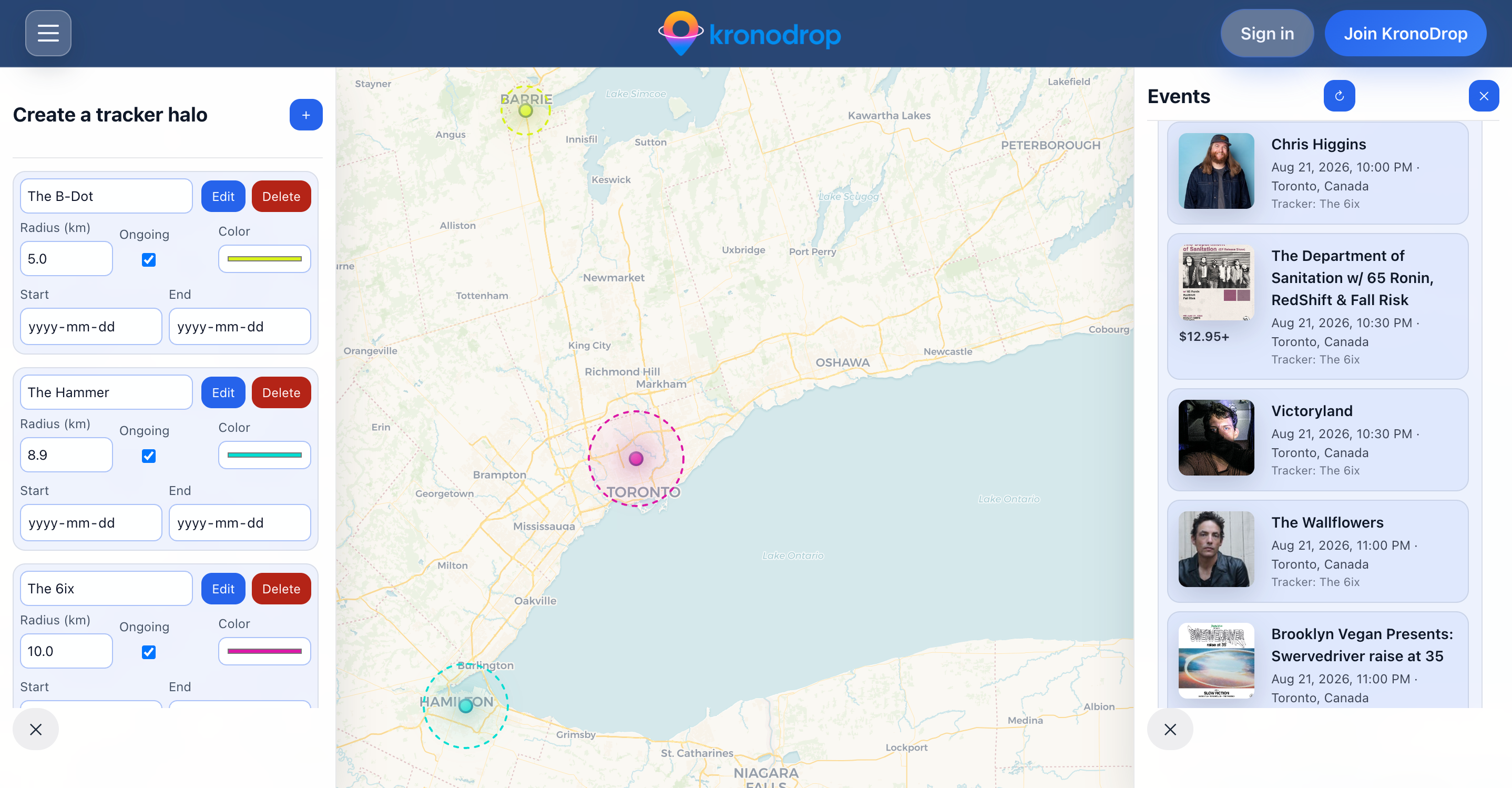
One of the projects I built before Octivary was an event discovery app called Kronodrop. The main idea revolved around a map. A user could drop little haloes over areas they cared about, and the app would look for events happening inside those general areas. It was basically a tiny digital fishing net for fun.
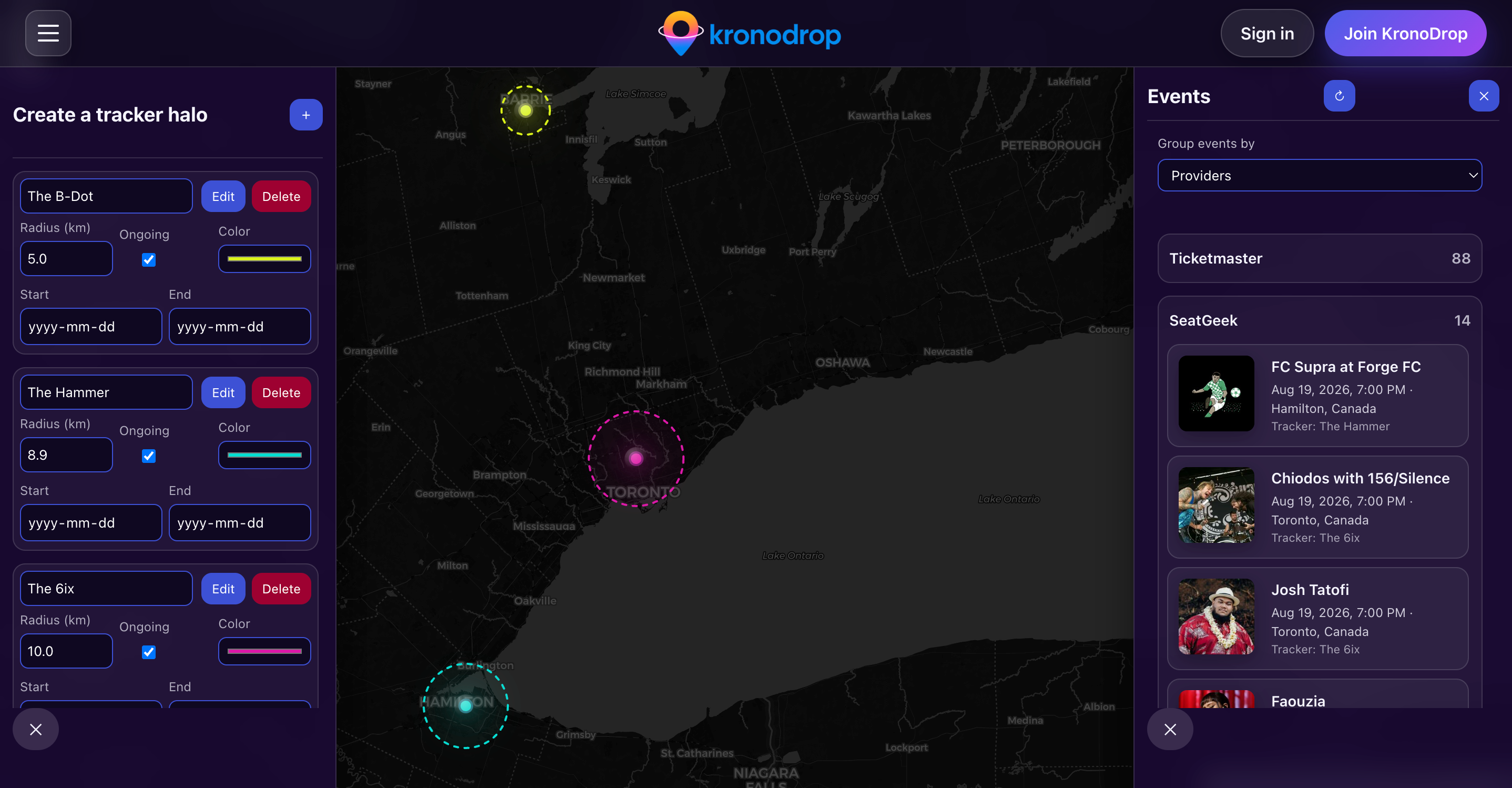
Behind the scenes, Kronodrop connected to event data through APIs. In normal-human terms, certain event companies allowed applications to request structured information about their listings. Kronodrop could ask for events around a chosen area, pull that data in and organize it for the user. The system worked well enough that users could create accounts, keep track of events and start building a useful little discovery history.
Then some of the partnership opportunities dried up. That is one of the rougher realities of building anything that depends on outside data. You can control your own code, but you cannot control every service feeding information into it. Access changes, pricing changes, products get retired, terms shift, and occasionally one of the structural beams holding up part of your project decides it would rather become decorative furniture.
Around the same time, Facebook’s event tools started leaning more heavily into time and location-based discovery. Users could select an area, choose a time and browse events happening around them. It felt close enough to the kind of problem I had been working on that I had one of those mildly haunted developer moments. To be very clear, I am not suggesting anyone had been rummaging through my laptop at 3 a.m. Ideas converge because multiple people notice the same pain point.
Still, seeing a giant platform move toward a similar concept felt oddly validating. Maybe the idea was not bananas after all. The location-and-time model is useful, but I always wanted to push one layer further. I did not just want to know what is happening around me. I wanted to know which of those things actually fits me best.
Apparently I have been trying to solve this since high school
This problem goes back even further for me. Around high school, some friends and I had an idea for a system where someone could enter a postal code, set a radius around it, choose musical artists they cared about and see nearby shows from those artists. Years later, apps like Bandsintown made concert tracking much more common, which again made me feel like maybe we had been circling something useful.
What frustrated me with some concert discovery tools was how noisy the experience could become. You follow artists you actually care about, then recommendations, promoted acts and other content begin crowding the screen until your personal feed starts feeling like somebody else’s festival poster. Ticket marketplaces can create the same effect. You open the homepage and the biggest tour in the country occupies half the screen, while you are searching for some comparatively obscure band whose Canadian tour consists of Toronto, Montreal, one brave stop in London, Ontario and then apparently disappearing into fog.
Big promotional campaigns naturally get more visibility. That is not some shocking conspiracy. It is just how commercial platforms tend to work. The downside is that smaller events can disappear under that current, even though one of those smaller events might be the exact thing somebody is hoping to find. That was one of the problems Kronodrop was trying to solve. I did not particularly care if an event expected fifty people or fifty thousand. I wanted the right event to reach the right person.
Years later, that idea has wandered back into the room wearing an Octivary badge.
The live-event problem is still a beast
There is one major limitation I need to be very clear about. I cannot yet make this Toronto Choice Compass reliably cover fast-changing pop-up events, concerts and one-night-only happenings. I would love to, because that is pretty much Kronodrop territory, but doing it properly would require fast and dependable streams of current information.
Concerts sell out. Pop-ups appear and vanish. Dates change. Venues move. Events get cancelled. New listings are posted constantly. To keep all of that trustworthy, I would need reliable APIs or similar feeds that update quickly enough to keep the compass from ranking something that disappeared three hours ago. That is a very different technical problem from maintaining more stable experiences such as museums, attractions, classes, tours, arcades or recurring activities.
Maybe someday. Kronodrop is somewhere in the basement rattling chains and yelling, I LIVE.
For now, I am focusing on experiences that are stable enough to research, score and maintain responsibly. That still leaves a very large chunk of The 6ix to work with.
What if experiences were ranked by what actually matters to you?
This is where the Choice Compass comes in.
Imagine you have Saturday free. You have worked all week and your brain has approximately eleven operational pixels remaining. You want to do something meaningful with the time, but you are not sure what. Instead of opening a directory and staring at hundreds of unrelated listings, you begin with your priorities.
Maybe there are two of you. You are comfortable spending $30 to $75 each. You want to stay indoors. You want something nerdy and interactive, but not intensely physical. You want to be able to talk. Food is not important. Nightlife is definitely not important. Two or three hours sounds about right, and something hands-on would be a bonus.
Those preferences can be compared against the characteristics of each experience. The goal is not simply to eliminate everything that fails one checkbox. Instead, the system can look at several considerations together and allow the experiences that match more of your priorities to rise toward the top. One option might align with eight things you care about, another with six, and another might technically qualify but miss the entire mood of the outing.
That is a very different result from, “Here are 437 things to do in Toronto. Godspeed.”
The goal is a shorter, ranked group of possibilities that are actually worth investigating.
What even counts as an experience?

This gets fuzzy surprisingly fast. Does a restaurant count? Absolutely. There are some fantastic restaurants in Toronto, and a meal can definitely count as an experience when the food, setting, service or overall atmosphere is a meaningful part of the outing. A chef-led tasting experience does too. A museum obviously does. A guided food tour does. A board-game café might. A spa treatment can. A workshop definitely can. A park becomes more interesting if there is an activity attached to it. A seasonal market can qualify, and if somebody is teaching medieval bookbinding while serving tea, please send me that listing immediately.
I am keeping the definition intentionally broad. If somebody is intentionally going somewhere or participating in something because the activity itself is a meaningful part of the outing, I am comfortable calling it an experience. Human recreation does not respect database normalization, which is rude but survivable.
What can I do in Toronto that is not the usual tourist stuff? This question gets answered online all the time, but the answers can be hilarious. You click something titled:
"Hidden gems in Toronto!"
Then the first suggestion has 11,000 Google reviews.
Hidden from whom? Astronauts?
I think the better way to answer this is to stop treating “not touristy” as the actual preference. Maybe what you really want is low crowds, locally loved, unusual, community-focused, hands-on or simply something that does not feel designed primarily for visitors. Those are much more useful characteristics to feed into a ranking system because they describe the experience you actually want instead of asking a search engine to interpret the mysterious spiritual meaning of the phrase “hidden gem.”
What can two adults do in Toronto that does not revolve around drinking? Quite a lot, despite the occasional impression that adulthood automatically unlocks a mandatory cocktail menu. Museums, gaming, comedy, workshops, climbing, theatre, markets, escape rooms, food experiences, arcades, spas, classes, exhibits and tours can all work. The real question is what you want from the outing. Do you want conversation, movement, competition, learning, calm, romance, novelty or chaos? Removing alcohol does not leave a smoking crater where your social life used to be. It simply gives the search better instructions.
How do I find something to do when I do not know what I want to do? This may be the most useful question of the entire experiment. Start with your current operating conditions instead of the activity. How much energy do you have? What is your budget? Do you want people around you? Do you want to learn something, move around, sit down, talk, compete, relax or try something weird? Do you want something uniquely Toronto? You may not know the activity yet, but once you answer those questions, you know a surprising amount about the shape of the experience you are looking for.
How I would use the Toronto Choice Compass
The most important thing is not to select everything you generally enjoy. Choose what matters for this particular outing. If you usually love history but tonight the real priority is laughing with friends, there is no reason to give history extra weight just because Past You once had a fantastic museum day.
Maybe tonight you care most about staying under $50, being indoors, having something interactive and getting two or three hours of high-energy fun with friends. Another time, the ranking might be completely different because you are planning a quiet date night and care about conversation, low physical intensity, something unusual and a slightly higher budget. Same person, different night, different priorities.
For an active outing that you want to turn into a routine, the Fitness Apps Choice Compass can help you compare a complementary way to plan movement between visits.
I would also encourage people to play with the selections. Change one or two things and see how the rankings move. That movement can tell you something useful about your own decision. Maybe “conversation friendly” completely changes your top results. Maybe your strict price preference is pushing away several options you would happily spend another $15 on. Maybe you thought you wanted something calming until an aggressively competitive activity appears near the top and your inner goblin immediately approves.
MCDA is not psychic. It is structured indecision, and I mean that affectionately.
Please still check the experience website
This part matters a lot. Considerable work goes into maintaining things-to-do listings, and experience information can change in ways that product specifications often do not. Prices move, activities change, age requirements get updated, accessibility details change, food options disappear, booking rules shift and certain parts of a venue may temporarily close.
Once the Choice Compass narrows things down to a few good options, please visit the experience’s own website and verify the important details before spending money or making plans. Think of Octivary as the narrowing machine, not the final person at the door holding the clipboard.
Also, verify my work. Seriously. If you notice something outdated or incorrect, leave feedback and tell me. Maintaining these listings is ongoing work, and I would much rather fix a bad field than leave somebody confidently marching toward stale information. If you spot something wrong, activate the tiny correction siren: wee woo wee woo.
Time is the resource hiding behind all of this
As I mentioned in a recent news post, time is an important part of our lives whether we choose to believe it is a tangible thing or not. We can gather the most scholarly people available, sit them around a giant wooden table and debate the philosophy of time until everyone needs snacks. We are still going to get older, wither and eventually develop suspiciously strong opinions about someone else’s lawncare.
Time wins.
That is ultimately why I care so much about making this process faster. Spending forty-five minutes deciding how to spend your three free hours is absurd. We have optimized countless other tiny decisions in modern life. Navigation apps reroute us. Music apps learn our listening habits. Streaming services rank entertainment. Shopping systems remember preferences. Yet when you ask the internet, “I have tonight free. Find me something interesting to do,” it can still respond with what is basically a homework assignment titled 75 Best Attractions in Toronto.
TL;DR: thanks, I somehow have research now.
I do not expect the Toronto Experiences Choice Compass to become a flawless oracle of recreation. Experiences are subjective. Information changes. One person’s “moderately active” is another person’s “why are there stairs and who authorized this?” Costs vary, vibes are difficult to quantify and some places can feel completely different depending on when you visit. There are going to be snags.
I still think we can do better than throwing hundreds of possibilities at somebody and calling that discovery. Maybe you are planning something romantic, maybe you are visiting The 6ix, maybe you have lived nearby forever and want proof that Toronto still contains something you have not already done, or maybe tonight’s original plan just collapsed and you are standing there in the outfit you bought specifically for it wondering what exactly the universe expects from you now.
Then there is the classic group chat: “What does everybody want to do?” followed by “No preference,” “I’m good with anything,” and “Same,” after which four people with allegedly zero preferences reject seventeen consecutive suggestions. This is what computers should have been invented for.
So that is what I am trying next. Not another giant directory and not another article titled 101 Things You Absolutely MUST Do in Toronto Before You Die, which feels unnecessarily threatening. A Choice Compass that asks what matters, uses those priorities to influence the rankings, gives you a shorter list to investigate, and helps you get out of the browser faster. Verify the details on the experience’s own site, make the plan and go do the thing, because finding the experience should not take longer than the experience itself.
Affiliate Disclosure
Octivary currently receives no affiliate or paid-placement compensation. Product rankings are based on the documented criteria and the priorities you choose.